Summary of a number of important findings from the IPCC’s latest report on climate change.
Is it too late to stop climate change? On 9th August 2021 the Intergovernmental Panel on Climate Change (IPCC) released their 6th Assessment Report, which discussed the most recent evidence and understanding of the physical science of climate change. This report had one clear message: climate change is here, now, and is a dire threat to the planet. However, following this message was another: there is still hope, provided we act now.
The report uses climate models and shared socio-economic pathways [1] to provide the clear information we need to push governments into action to tackle global climate change. Here are 5 key takeaways of the report you need to know:
1) Global warming is undoubtedly driven by human-induced emissions.
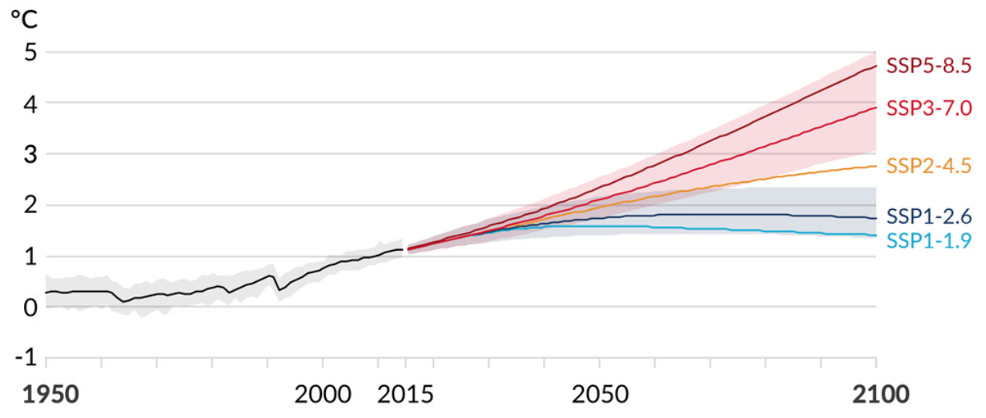
The report makes it clear that global warming is unequivocally caused by emissions from human activities [2]. These activities include energy production, agriculture and land-use change, and industry. Since 1850 each decade has been successively warmer than its predecessor, with global mean surface temperature of the decade 2011-20 having increased by 1.09°C since the pre-industrial baseline period 1850-1900 [3]. This warming has been attributed to observed increases in greenhouse gas concentrations since the 1750s [4]. For example, in July 2021 atmospheric CO2 concentrations were at 417ppm, which is substantially above the pre-industrial concentration of 280ppm [5]. By emphasising from the start the explicit role of human activities in climate change, the IPCC report allows for no ambiguity in where solutions to the climate crisis and emissions reductions need to come from.
2) The impacts of climate change can be seen everywhere across the globe.
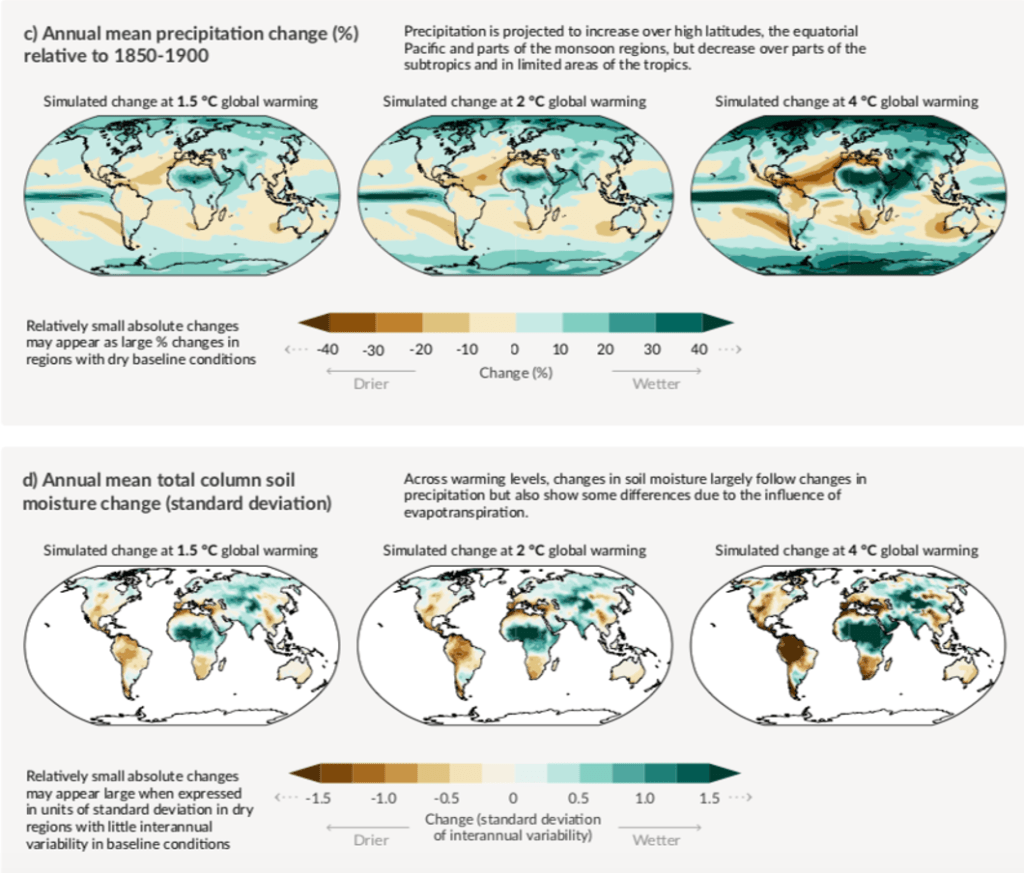
One of the key points emphasized in the report is that the impacts of climate change are affecting every region on the planet, with each instance being more drastic than the last [6]. Furthermore, the impacts of climate change are not uniform across the globe, with regional impacts varying in type, frequency and intensity. This report is the first to include specific regional information on local climate impacts and projections, which significantly enhances the understanding of climate change and its impacts. This specific regional information, as well as the acknowledgement of the non-uniform nature of impacts across the globe, will allow adaptation approaches and strategies to be more targeted and work more effectively. If you are interested in understanding more about regional climate information, visit the IPCC’s new digital atlas here.
3) Projections show that extreme weather events will become more intense and frequent in the future as temperature increases.
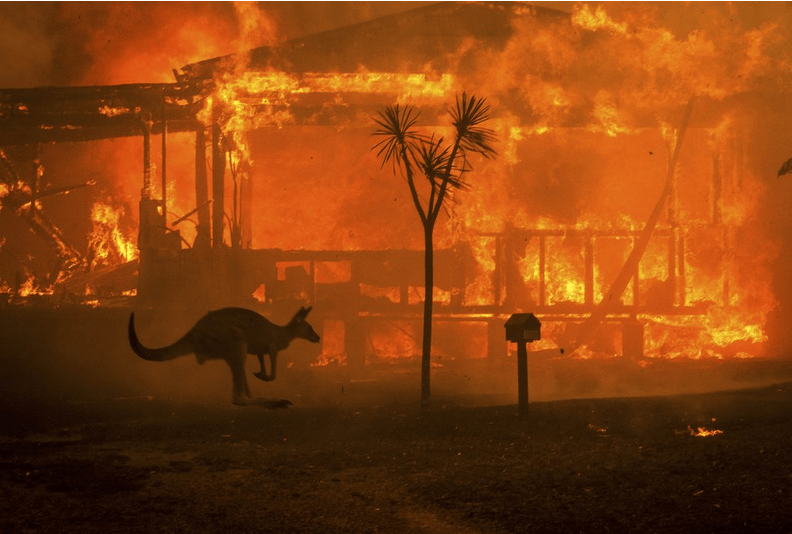
Climate projections show that extreme weather events are likely to become more frequent and intense as global temperature increases [7], [8]. For example, regions such as Australia, western USA and Southern Africa will experience increased droughts and fires, events which have already affected livelihoods, agriculture and biodiversity. Meanwhile, storm events will intensify over Europe and North America. The report particularly emphasized how every fraction of a degree of warming will result in more significant impacts, especially those related to extreme events, which could mean even more devastating impacts on livelihoods and environments.
4) Carbon Capture and Storage (CCS) is becoming an increasingly necessary solution to the climate crisis.
Despite the negative takeaways from the report, it is made clear that if within this decade we take very ambitious action to curb emissions, it is still not too late [9]. However, these actions cannot be small-scale efforts, instead, rapid, large-scale, transformational change will be required. There is a particular focus, in the report, on carbon removal to reach net-zero carbon emissions. Carbon removal, such as through CCS, can compensate for sectors that are difficult to decarbonise, such as aviation. More information on this will follow from the report by the IPCC’s Working Group III that focuses on the mitigation of climate change, which is planned to be released in March 2022.
5) If we can act NOW to stop emissions, we can still limit warming to 1.5°C and avoid catastrophic climate change
The report demonstrates that our understanding of climate change and its impacts is stronger than ever. We now have a very clear set of information that allows us to know where we are heading and what needs to be done. Now we must feed that information from scientists to governments and policymakers and encourage them to work together.
Ultimately, we can still limit warming to 1.5°C. with combined efforts to rapidly implement effective and large-scale action to stop emissions, but every year that action is delayed, or every fraction of a degree the temperature rises, the harder it is to prevent a future of catastrophic climate change. Furthermore, limiting warming to 1.5°C must happen simultaneously with other global goals. The planet is facing a number of challenges, many of which are exacerbated by the climate crisis. Therefore, we need to make sure that development, progress and solutions related to climate change can assist and go hand in hand with other goals such as the eradication of poverty and sustainable development [10].
Given this information, it is clear that action needs to happen, and it needs to start now. The COVID-19 pandemic has shown us that society is capable of making huge changes in response to a dire threat, so we know that we are capable of making the changes needed to fight the climate crisis. While at first glance the IPCC report might seem disheartening, distressing and even damning, it is important to remember that there are a number of positives to takeaway. Most importantly, there is still a chance to limit warming to 1.5°C and avoid a future of catastrophic climate change, provided we get our act together now and really work to stop emissions. Hopefully this report will act as a wake-up call to governments all over the world to take serious and large-scale action immediately.
 Abi Jones
One thought on “The IPCC’s 2021 Climate Report: 5 things you need to know about climate change”