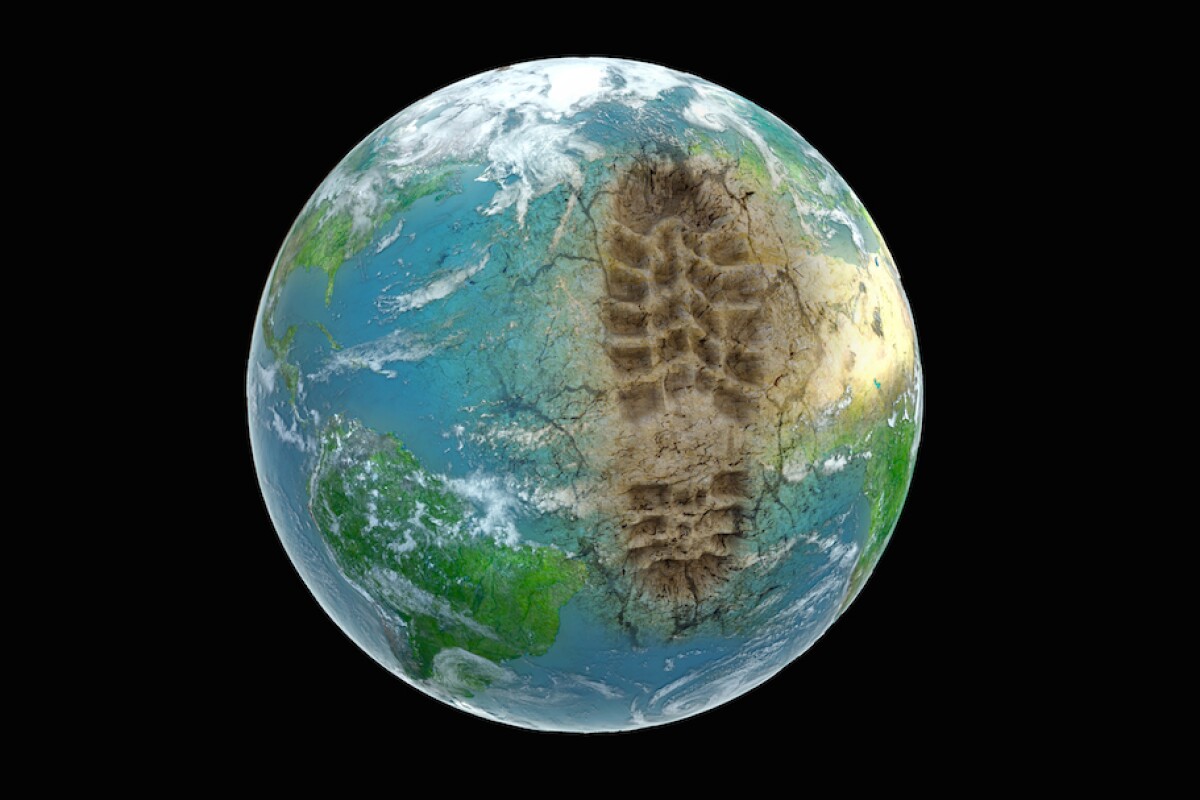
The Anthropocene is a new concept to many but is something that we should all be aware of as human impacts on the planet become increasingly dominant.
The Anthropocene is the concept that the Earth has moved into a novel geological epoch characterised by the human domination of the planetary system. The term was originally proposed Paul Crutzen in 2000 who initially suggested that the start date could be linked to the onset of the industrial revolution [1]. The aim of the term is to capture the multi-faceted nature of environmental change and emphasise the magnitude of human influence. A major feature of the Anthropocene is the idea that human dominance is leading to feedback loops in the system that are pushing the Earth towards its nine planetary boundaries and ultimately setting the planet on a new trajectory [2, 3]. These planetary boundaries cover all aspects of the earth system and suggest thresholds, within which humans can live safely on Earth without crossing dangerous tipping points in the earth system.
Here, evidence for the Anthropocene within each of the earth systems – biosphere, lithosphere, hydrosphere and atmosphere – will be demonstrated to show that the earth is set on a new trajectory and that we are indeed in a new geological epoch.
Biosphere:
Human activity is altering diversity, distribution, abundance and interactions of life on earth through the conversion of ecosystems into agricultural or urban anthromes (anthropogenic biomes). These changing patterns are likely to reset the evolutionary path of the biosphere and have long lasting legacies, enduring on timescales ranging from thousands to millions of years or more. One of the main ways in which changes caused by the Anthropocene are negatively impacting the biosphere is through species extinction. One of the planetary boundaries is the rate of biodiversity loss, with the safe level being an annual rate of <10 extinctions per million species. Although the number of species on earth, and therefore the rate of extinction, is highly uncertain, current rates of species loss are 100-1000 times higher than the background rate [4]. Since 1500, 322 terrestrial vertebrates have become extinct [5] as a result of human influences such as habitat loss and the introduction if invasive species. Land use conversion, mainly for agriculture and timber production, has increased extinction rates and may result in a mass extinction event – the Sixth Extinction [6]. The mass extinction of species, especially key stone species, will have cascading effects to all systems on a global scale, with food webs and biogeochemical cycles being impacted at all levels. For instance, the abundance of insects has decreased by 45% as a result of human activities (predominantly deforestation, agricultural intensification and climate change) [7]. This is likely to have knock-on effects as over 80% of flowering plants rely on insect pollination, and insects have key roles in the food webs of ecosystems [7].
Impacts of human domination of the biosphere can also be seen in the mixing of biodiversity. This mixing began during the Colombian exchange, which set up the trade of plants and animals across the world. In 2020, this interface between humans and animals that has been enabled by the commodification of wild animals and the global patterns of travel and trade resulted in the emergence of the COVID-19 pandemic [8]. This example highlights the extent of human influence across the world.
Lithosphere:
Human activities of ‘mass-action’ associated with agriculture, construction and mining have largely overtaken the natural geomorphic systems that shape the lithosphere and its landscape [9]. Rock uplift and erosional denudation of orogenic belts where originally the most dominant geological processes, but instead now humans are the most important geomorphic agent, with agricultural practices alone displacing around 20,000 Gt of soil through cropland erosion over the history of civilisation [10]. The large spatial extent of cropland erosion makes a clear argument for the significant impacts of humans on the environment and the planet’s system processes. Not only does this have direct effects on denudation rates and landscape formation, increased erosion also affects the hydrological system due to increased river sediment loads and storage behind dams – between 1950 and 1985 there was a 30% increase in the storage if sediment behind dams in large reservoirs due to enormous volumes of farmland sediment stored as post-settlement alluvium [11].
Hydrosphere:
In the early 20th century mechanisation related to earth removal, mining, terracing and deforestation led to global signals in increased sediment discharge in most large rivers, significantly affecting hydrological systems worldwide. By the 1950s this sediment discharge signal had reversed for most major rivers as a result of dam and reservoir construction for water storage and hydroelectricity – by 2011 there were 48,000 large dams globally and 2000 under construction [12]. Ultimately, it seems that regardless of the direction of change, human actions have a large control on the hydrosphere.
Atmosphere:
Anthropogenic impacts have resulted in the composition of the atmosphere significantly shifting since the Holocene. Greenhouse gas concentrations have seen huge increases in the recent past, with over 555 petagrams of carbon being released into the atmosphere since 1750, and the global mean temperature for 2020 was 1.2+- 0.1 °C above pre-industrial levels [13]. The most prominent greenhouse gases seen in the atmospheric composition are carbon dioxide and methane. Increased carbon dioxide levels are a result of fossil fuel combustion and the removal of carbon sinks through deforestation, while increased methane is largely due to livestock rearing. According to the planetary boundaries the safe value of atmospheric conditions that would prevent the earth system crossing a dangerous tipping point are 350ppm [2]. However, the current level in May 2021 was 419ppm [14], arguably making humans the driving force in the climate. This has large temporal and spatial impacts which are often seen through anthropogenic global warming, as well as resultant feedback loops which accelerate and accentuate the processes.
Clearly, there is a mounting body of evidence that the Earth is on a new trajectory as a result of the dominant influence of humans on the planet. Does this mean we are now in a new geological epoch, termed the Anthropocene? And if so, what does this mean for how we should see the influence of humanity on the planet, and ultimately the actions we need to start making to prevent tipping points and planetary boundaries from being reached?
[1] Crutzen and Stoermer (2000) The Anthropocene. IGBP Global Change Newsletter. Royal Swedish Academy of Sciences, 41: 17-18.
[2] Rockström et al. (2009). a safe operating space for humanity. Nature, 461, 472–475.
[3] Malhi (2017) The Concept of the Anthropocene Annual Review of Environment and Resources 2017 42:1, 77-104.
[4] IPBES (2019) Global assessment report on biodiversity and ecosystem services. Access at: https://www.ipbes.net/sites/default/files/inline/files/ipbes_global_assessment_report_summary_for_policymakers.pdf
[5] Dirzo et al. (2014) Defaunation in the Anthropocene. science, 345(6195), pp.401-406.
[6] Barnosky et al. (2011) Has the Earth’s Sixth Mass Extinction Already Arrived? Nature 471(7336): 51-7.
[7] Wagner (2020) Insect declines in the Anthropocene. Annual review of entomology, 65, pp.457-480.
[8] Battistoni (2020) Anthropocene Politics. Perspectives on Politics, 18(3), pp.881-885.
[9] Haff (2010) Hillslopes, rivers, ploughs, and trucks: Mass transport on Earth’s surface by natural and technological processes. Earth Surface Processes and Landforms 35 (10): 1157-1166.
[10] Wilkinson and McElroy (2007) The impact of humans on continental erosion and sedimentation. Geological Society of America Bulletin, 19 (1-2): 140-156.
[11] Vörösmarty et al. (2003) Anthropogenic sediment retention: major global impact from registered river impoundments. Global and Planetary Change, 39 (2003), pp. 169-190.
[12] Syvistski and Kettner (2011) Sediment flux and the Anthropocene. Phil. Trans. R. Soc. A, 369: 957–975.
[13] https://public.wmo.int/en/our-mandate/climate/wmo-statement-state-of-global-climate
[14] https://gml.noaa.gov/ccgg/trends/
 Abi Jones